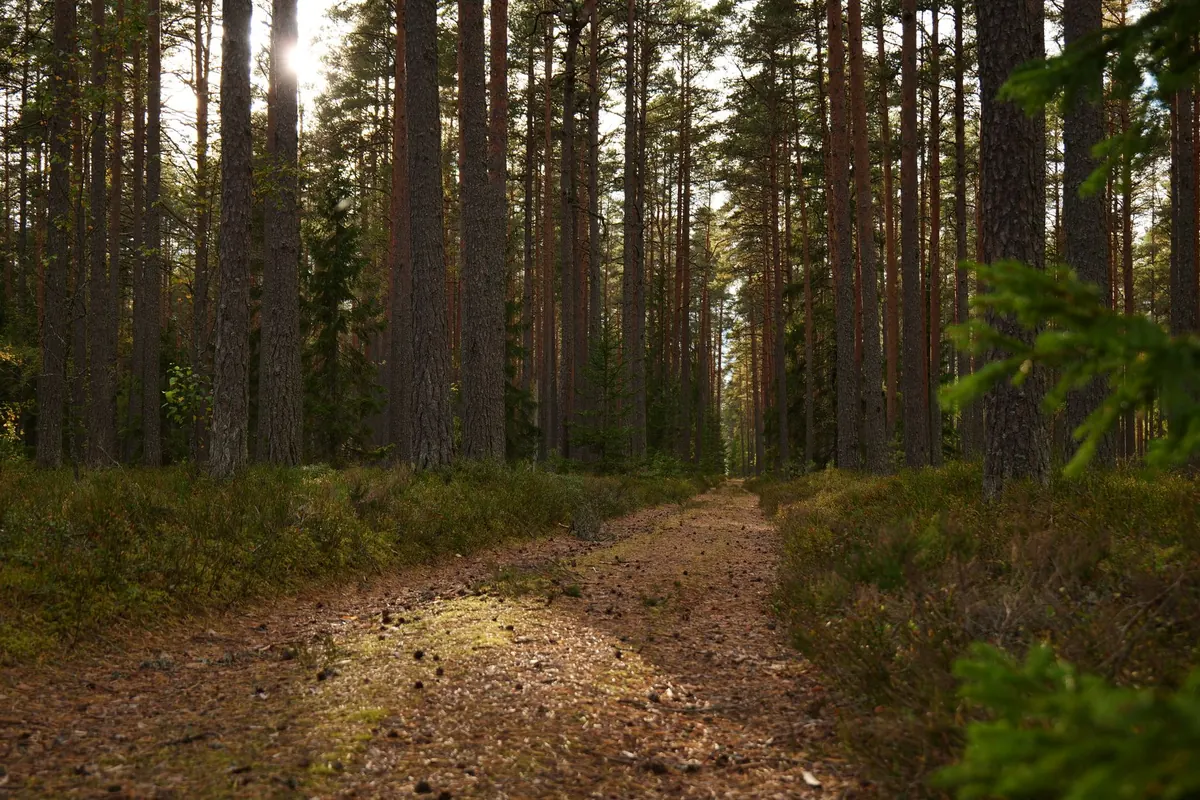
Somewhere within a short drive of most people in Britain there is a wood where the path softens underfoot, the light arrives in pieces, and the loudest thing is a pigeon clattering out of a beech. Forest bathing is the practice of going there and letting it work on you. No route, no pace, no personal best to beat. The term comes from Japan, where shinrin-yoku was coined in the 1980s to encourage people into forests for their health, and it has settled into Britain easily because it suits our small, muddy, endlessly varied woodlands. Here is what it involves, why it is worth the time, and how to run a session this weekend.
What Forest Bathing Is, and What It Isn't
It is not a hike with meditation bolted on, and it is not a foraging course or a natural-history exam. Nothing needs identifying. No route needs completing. The only skill involved is attention, and the only ambition is to slow down enough to use it.
That means walking at perhaps half your normal speed, and stopping whenever something catches you: the smell of wet bark, a woodpecker working somewhere off to your left, the way moss holds light. You might cover less than a kilometre in an hour. That is fine. Distance belongs to a different sort of day out.
You can do it alone or in a small group, in silence or with quiet conversation, in sunshine, drizzle or fog. You can sit on a bench, a log or a folded waterproof. It costs nothing, needs no equipment beyond what you would take on any short walk, and fits into an hour.
Why the Woods Do You Good
The research on time in nature is encouraging rather than miraculous. People generally report feeling calmer, sleeping better and thinking more clearly after time among trees, and the effects appear to be real even where the mechanisms are still being untangled. You do not need the science to justify the walk, but it helps to know what you are aiming for.
Some of the benefit is obvious. You are moving, breathing cooler air and looking at things that are not backlit rectangles. Some of it is subtler: woodland sound is layered but rarely loud, light shifts constantly, and nothing out there demands a reply. There is no notification, no queue, no small decision to make. Your shoulders drop because there is nothing to brace against.
Pace matters too. Most walks are quietly goal-driven, even the pleasant ones, and a goal keeps part of your mind switched on. Forest bathing takes the goal away. That is why many people find it easier to settle into than they expect, including people who insist they are no good at sitting still.
A note on health: time outdoors suits most people, but if you have a heart or lung condition, limited mobility, are pregnant, or are recovering from illness or injury, speak to a GP or another healthcare professional before a long or strenuous outing, and choose flat, well-surfaced paths.
Before You Go
You need very little. A few small decisions, though, are the difference between a lovely hour and a cold, itchy one.
- Pick somewhere close. A scruffy council wood ten minutes away will be visited far more often than a famous forest two hours off.
- Check the paths. Waymarked trails, easy-access routes and downloadable maps are listed by the organisations that manage most public woodland.
- Dress for standing still. You will get colder than you would on a normal walk of the same length. An extra layer and something waterproof beat good intentions.
- Bring your phone, then silence it. Useful for maps and emergencies, ruinous as a companion.
- Tell someone your plan if you are heading somewhere remote, and assume signal will vanish.
- Think about insects. Midges can be fierce in the Highlands and west coast on still summer evenings, and ticks sit in long grass and bracken from spring to autumn. Long trousers, then a proper check afterwards.
- Go early or go late. Woodland at 7am or an hour before dusk is a different place: more birds, fewer people, better light.
One more thing: leave the headphones at home. Birdsong is part of the treatment.
A Slow Session, Step by Step
Try this on your first outing. An hour is plenty; forty minutes will do.
- Arrive and stop. Before you go anywhere, stand at the edge of the wood for two or three minutes. Let your breathing lengthen and your eyes adjust. Most people rush this part, and it is the part that sets up the rest.
- Walk at half speed. Let your feet roll from heel to toe. Notice the change in sound as you move from gravel to leaf litter to mud.
- Take your senses one at a time. Five minutes on sound, then five on smell, then five on touch: bark, leaf, the temperature of the air in shade compared with sun.
- Find a sit spot. A log, a bench or a dry bank will do. Stay fifteen or twenty minutes. Restlessness in the first five minutes is normal and usually passes.
- Close on purpose. Before you leave, turn and look back the way you came. Note three things you would have missed at normal walking pace, then go home.
If you find it hard to settle
Try a wider focus rather than a narrower one. Fix on a point at eye level and let your gaze soften until you are taking in the whole view. Or use a simple anchor: the sound of your own footsteps, or counting breaths to six and starting again. If your mind keeps rehearsing tomorrow, let it. You have not failed; you have simply noticed what your mind is doing, which is most of the work.
Doing it with other people
Agree a slow pace and a rough finishing time before you set off, so nobody feels obliged to talk. Children are often better at this than adults, so follow their lead when they stop to look at something. A group of three or four works well; larger groups tend to turn into a walk.
Finding Your Wood
Public access woodland is everywhere in the UK. Forestry England, the Woodland Trust, the National Trust and the Wildlife Trusts all manage woods you can wander into, and most councils look after at least one. Beyond that, the variety is the pleasure: the beech hangers of the Chilterns, the oakwoods of Wales, the pinewoods of the Cairngorms, the New Forest, Epping Forest, the woods at the end of your road.
Ancient broadleaved woodland feels quite different from a conifer plantation, and both are worth an hour. Match the wood to your mood. Broadleaf for birdsong in May, pine for that resinous air that clears the head in February, anything at all when you simply need to be out.
Start Small and Go Often
Once a week beats once a season. A short session you actually do is worth more than an ambitious one you keep postponing, so put it in the diary the way you would a haircut and treat a local wood as your default.
Go in the rain at least once. Wet woodland is quieter, emptier and smells extraordinary. Go in winter, when the shape of the place is visible without its leaves. And resist grading yourself: there is no correct way to sit under a tree, and no session that counts as a failure.
If you would like company, guided forest bathing sessions run across the UK and can be a gentle way in, particularly if you are grieving, stressed or simply unsure where to start. Otherwise, choose a wood, leave the house, and give yourself an hour with nothing to achieve.
Photo: Lauri Poldre / Pexels